

Buying a car from Copart looks simple from the outside. Create an account, find a vehicle, place a bid, pay, and pick it up. For a buyer in the United States who already owns a truck and trailer, that is close to the whole story.
For a buyer outside the United States, it is not. Before that car ever reaches a driveway in Warsaw, Dubai, Erbil, Ashgabat, or Kyiv, a lot has to happen correctly: the right membership and licensing route, a title or document type that actually suits the buyer's plans, a bid that accounts for fees the buyer has not seen yet, a payment made through the right channel before a short deadline, a fast pickup to avoid storage charges, and then a full export and shipping process before the car is anywhere close to home.
This guide walks through that entire journey, not just the auction part of it. It draws on Copart's own published buying rules, U.S. Customs and Border Protection's vehicle export regulations, and the operational experience of Peace Global Logistics (PGL), an Official Copart Broker listed in Copart's own broker directory, that handles vehicle purchasing, U.S. pickup, and international shipping for buyers around the world. Where a rule or a fee can change, that is flagged clearly, because it can, and it does. PGL Shipping's listing in Copart's broker directory includes bidding, buying and consulting, financing, shipping, vehicle customs clearance, document delivery, inspection, ownership transfer, registration and vehicle repair services.
Key Takeaways
- Copart is an online vehicle auction marketplace, not a car dealership. It connects sellers, including insurance companies, banks, fleets, dealers, and other vehicle owners, with buyers worldwide.
- International buyers can register and bid on Copart, but eligibility for certain vehicles depends on business documentation, state requirements, and the type of vehicle being purchased.
- The winning bid is never the total cost. Buyer fees, gate fees, taxes, towing, storage, title work, and international shipping all sit on top of it.
- "Run and Drive" and "Engine Start Program" describe a vehicle's condition at intake, not a guarantee of how it will run when picked up or shipped.
- A vehicle's title or document type, clean, salvage, rebuilt, nonrepairable, parts only, affects what can be done with it later, and export eligibility from the U.S. is a separate question from import eligibility at the destination.
- After winning, buyers face a short payment window and a limited free storage period before daily fees begin, so pickup and transport should be arranged before bidding starts, not after winning.
- Buying directly requires meeting Copart's eligibility and logistics requirements yourself. A Copart Registered Broker, such as PGL, can bid and purchase on a buyer's behalf and coordinate pickup, export, and shipping as one connected process.
What Is Copart and How Does It Work?
Copart is a global online vehicle auction marketplace where insurance companies, banks, fleet operators, rental companies, dealers, municipalities, charities, and other sellers offer used, wholesale, clean title, and salvage vehicles to buyers around the world. Buyers can search vehicle lots, review title and condition information, bid online, pay for vehicles they win, and arrange pickup or transportation after the sale.
Most vehicles on Copart come from insurance companies selling cars that were declared a total loss after an accident, theft, flood, or fire. That is why Copart is so closely associated with salvage cars. But insurance total losses are only part of the inventory. Copart also sells vehicles on behalf of banks and finance companies repossessing loans, rental and fleet companies rotating out older vehicles, dealers wholesaling trade-ins, charities liquidating donated vehicles, and individuals selling directly. A meaningful share of Copart's inventory carries a clean title and runs and drives normally; it simply moved through Copart's channel instead of a traditional dealer lot.
Bidding happens on Copart's own online platform, called VB3. Every listing is a "lot," identified by a lot number and a VIN, with photos, a title or document type, an odometer reading, a primary and often secondary damage description, and a sale date. Buyers who register as members can preview many vehicles in person during a yard's regular business hours before bidding, which is the only reliable way to see a vehicle beyond its photos.
Are all Copart vehicles damaged or salvage titled? No. Copart's inventory ranges from lightly used, clean title vehicles sold by rental and fleet companies to heavily damaged salvage and nonrepairable vehicles sold by insurers. The title or document type listed on each lot, not the fact that it is on Copart, is what tells a buyer what condition and paperwork situation they are actually bidding on.
Can International Buyers Buy Cars From Copart?
Yes. Copart accepts registrations from buyers around the world, and a large share of its auction activity comes from international bidders, particularly buyers planning to export vehicles for resale, rebuilding, or parts in their home markets. International buyers use largely the same platform, membership structure, and bidding tools as U.S. buyers, with a few practical differences.
Copart treats international individuals and international businesses as two separate registration paths, and it is worth knowing which one applies to you before you start. An international individual typically registers using a passport or other accepted government issued identification rather than a U.S. driver's license as the primary identification document. An international business is generally asked to go further and submit documentation such as a dealer, import/export, or other applicable business license from its own country, tax or VAT registration, and English translations of anything not already in English, with the company name on those documents matching the name used to register. That business documentation can open up more inventory than a plain individual account, but it is still evaluated by Copart, and it does not automatically make every vehicle available to the account.
Wire transfer is the most reliable and preferred payment method for international buyers, particularly because other payment options may have eligibility or transaction limitations. International wires can also take time to clear and be applied to an account, so funds should be prepared with that delay in mind rather than at the last moment.
Copart also supports international buyers through a network of regional buyer lounges and Registered Brokers in various countries, which exist specifically because licensing, payment, and logistics work differently for someone bidding from outside the United States.
None of this means an international buyer can treat every listing the same way a U.S. dealer would. Two questions matter more for an international buyer than almost anything else: whether the buyer is eligible to purchase a given vehicle, and whether that vehicle can actually be exported from the United States and legally used at the destination. Both are covered below.
Do You Need a License to Buy From Copart?
Not always. Copart has No License Required vehicles that eligible registered members can purchase without a business or dealer license. However, many vehicles in Copart's broader inventory do require approved business credentials, depending on the vehicle, title type, and state where it is being sold.
International buyers who do not have the required eligibility can purchase through a Copart Registered Broker such as PGL. This gives buyers access to eligible restricted inventory without having to manage the licensing and purchasing process themselves.
Can an international buyer use a foreign business license? Yes, in many cases. Businesses registered outside the United States can submit qualifying dealer, import/export, or other business documentation from their home country to request access to business inventory. Approval still depends on the state, vehicle, ownership document, and credentials on the account.
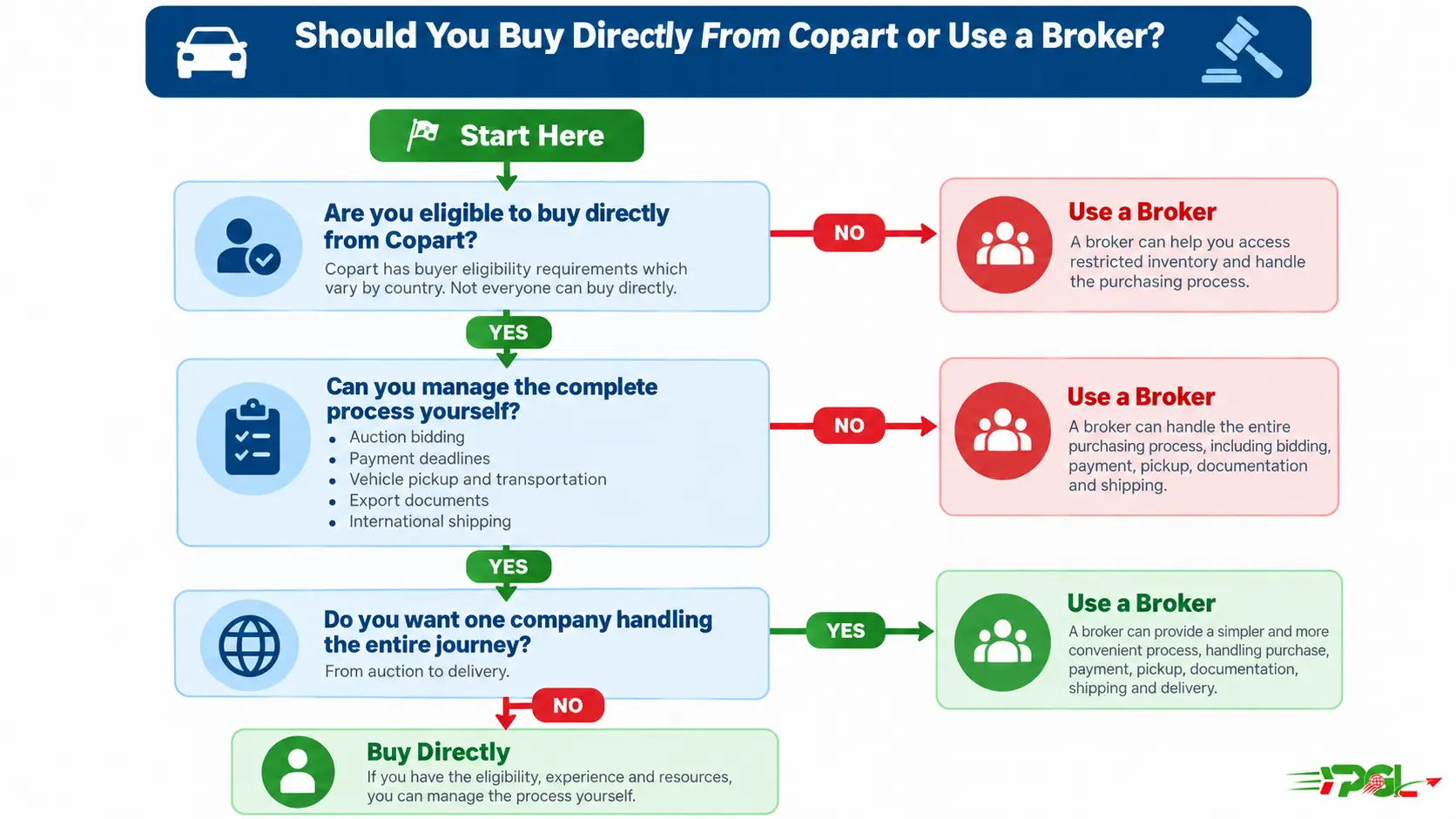
If a listing requires licensing or eligibility you do not have, purchasing through a Copart Registered Broker is one of the main alternatives. In practice, international buyers have three routes: buying through an individual account, registering as an international business, or purchasing through a broker such as PGL.
| Buying route | How it works | Best suited for |
| Individual account | Register with government issued ID and bid on No License Required and other eligible inventory | Occasional buyers and anyone whose target vehicles do not require additional eligibility |
| International business account | Submit business licensing, tax/VAT, and translated documents to request broader inventory access | Dealers, importers, and buyers purchasing regularly who can provide qualifying business documentation |
| Official Copart Broker | An independent company purchases on your behalf using its own account and credentials | Buyers who lack the required eligibility, are new to Copart, or want purchasing and logistics handled together |
A higher membership tier does not by itself unlock more restricted inventory. Buying power and membership tier affect how much you can bid; the licenses, business documentation, and state rules attached to your account determine what you are allowed to bid on. Those are two different systems, and it is easy to assume that upgrading your membership solves an eligibility restriction when it does not.
What Is a Copart Broker and When Do You Need One?
An Official Copart Broker is an independent company, separate from Copart, that can purchase vehicles on Copart's platform for clients who cannot or prefer not to buy directly. This distinction matters more than it sounds like it should, because it changes who you are actually transacting with.
When you buy through a broker, you are the broker's customer. You pay the broker, a deposit, the winning bid amount, and the broker's own service fee or terms, and the broker is the party that holds the Copart account, places the bid, and completes the purchase with Copart. Copart's contractual relationship is with the broker; yours is with the broker as well, under whatever terms and conditions that broker sets. This is different from buying directly, where you register your own Copart membership and Copart's terms apply to you as the buyer of record.
International buyers typically consider a broker when one or more of the following is true:
- The vehicle they want requires eligibility they do not have.
- They want an experienced bidder placing and managing bids rather than doing it themselves for the first time.
- They live outside the United States and would rather have a single company handle purchasing, pickup, and international shipping than coordinate several vendors separately.
- They want bidding assistance from someone who understands damage codes, title types, and the wider logistics process.
PGL operates as an Official Copart Broker and is listed in Copart's own broker directory. PGL Shipping's current broker listing includes bidding, buying and consulting, financing services, shipping, vehicle customs clearance, document delivery, inspection services, ownership transfers, registration services and vehicle repair services.
As with any broker, that access comes with the broker's own fees and terms, on top of Copart's own charges, so it is worth weighing against the cost and effort of qualifying to buy directly. That trade-off is covered in more detail later in this guide.
How to Buy a Car From Copart, Step by Step
1. Choose your buying route
Before you search for a car, decide how you will buy it: with your own Copart account, or through a broker. This one choice shapes the rest of the process. It decides which vehicles you can bid on, how you pay, and who your contract is with.
Buying directly works best if you already have the license or documents your target vehicles require, and you can arrange U.S. pickup and shipping yourself. A broker works best if you don't have that eligibility, are new to Copart, or want one company to handle both the purchase and the shipping.
2. Understand membership and buying power
Copart's current structure includes a free Guest tier for browsing, a Basic Membership at $99 per year, and a Premier Membership at $249 per year plus a one time $400 fully refundable deposit. Bidding eligibility itself is governed by the licenses and documentation on file, not by which membership tier you hold; membership tier mainly affects your buying power and account features.
Basic members can bid on one vehicle at a time up to $2,000 without adding a deposit. To bid higher, the required refundable deposit is generally 10 percent of the maximum amount the buyer wants to bid. Premier members can bid up to $100,000 with the one time $400 refundable deposit and may request approval for Buying Power beyond that amount.
Buying power is not the same thing as your budget, and it helps to keep the two separate in your own head. A buyer might have enough buying power on their account to place a $15,000 bid and still decide, after working through fees, towing, and shipping, that $11,000 is the most the vehicle is actually worth to them. Copart's system will happily let you bid your full buying power; it has no way of knowing what the vehicle will really cost you once it leaves the yard.
Membership level and buyer fee pricing are separate. A new Copart account does not automatically receive the lower Preferred Pricing schedule. That pricing depends on the account's purchase volume and annual spend, which is explained in the fee section below.
The Copart account will return to normal status after purchasing at least 25 vehicles with a total purchase value of $75,000. At that point, the account will be considered a regular account, and standard auction fees will apply.
3. Search for the right vehicle
Copart's Vehicle Finder tool lets you filter inventory by make, model, year, title or document type, damage type, location, and sale date. Saved searches and watchlists, available to registered members, are worth using if you are tracking a specific type of vehicle rather than a single lot, since new inventory is added continuously.
Location deserves more weight than most first-time buyers give it. Two nearly identical vehicles at the same auction price can have very different real costs depending on where they sit: one might be a short tow from a loading facility, and the other several states away. Island and remote locations carry their own premium too. A vehicle sitting in Hawaii, for example, is generally going to cost meaningfully more to move internationally than the same car on the mainland, simply because of how it has to leave the state. None of this should rule a vehicle out, but it belongs in the total cost calculation covered later in this guide, not as an afterthought once you have already won.
4. Research the VIN and vehicle history
Every lot lists a VIN, which is the starting point for independent research, not the auction listing's damage description alone. Copart's own lot pages link to third party vehicle history and condition report services. These reports are a useful cross check but are compiled from reported data, which can be incomplete, so they should support your judgment rather than replace inspection of the photos and listing details.
5. Understand damage and condition terminology
Copart uses a standardized vocabulary to describe a vehicle's condition. Understanding what each term actually promises, and does not promise, is one of the most valuable things an international buyer can learn before bidding, because these terms are frequently misread as guarantees.
Run and Drive means that when the vehicle arrived at Copart's facility, it started, could be shifted into gear, and moved forward under its own power. It is a record of a moment in time, not a mechanical certification. There is no guarantee the vehicle will start or move under its own power by the time it is picked up, and responsibility for inspecting and evaluating the vehicle before bidding rests with the buyer.
Engine Start Program is a narrower designation: the vehicle started and idled when it arrived, but there is no representation that it can be put into gear or driven. It is a weaker signal than Run and Drive, not a stronger one, despite sounding similar.
Enhanced Vehicle means the vehicle is part of Copart's cosmetic service, such as a wash, vacuum or protective covering, to improve how it looks for sale. It says nothing about mechanical condition.
Two related figures appear on many listings and are easy to over trust. ERV, Estimated Retail Value, is the seller's estimate of the vehicle's pre-damage retail value, not an appraisal the buyer should treat as guaranteed. Repair Cost is a seller submitted estimate of what repairs might cost, and actual repair costs can vary with labor rates, parts availability, and the buyer's own assessment of the damage; it should be treated as a rough reference point, not a quote.
Reading the photos carefully matters as much as reading the codes. A few things deserve particular attention: missing keys, which can add real cost, especially on newer vehicles with immobilizer systems; deployed airbags, a signal of a harder impact and a real replacement cost; any indication of flood or fire damage, which can affect wiring, electronics, and structural integrity well beyond what is visible; undercarriage and frame damage, often the hardest category to fully assess from photos; and any note of mechanical uncertainty. None of these are reasons to avoid a vehicle outright, but each is a reason to slow down, look closely, and, where possible, arrange an in person or third party inspection before bidding.
Common Copart damage codes
| Code / Category | General meaning |
| Front End | Impact to hood, bumper, fenders, grille, headlights, or front frame rails |
| Rear End | Impact to rear bumper, trunk, tail lights, or rear frame |
| Side | Impact along one or both sides, including doors and pillars |
| All Over | Damage spread across multiple panels or areas, often from a rollover or multi impact event |
| Top / Roof | Damage concentrated on the roof structure |
| Water / Flood | Water intrusion, which can affect electronics and mechanical systems beyond visible staining |
| Hail | Body panel dimpling from hail, usually cosmetic |
| Burn | Fire damage, ranging from localized to total loss |
| Vandalism | Intentional damage, condition varies widely |
| Mechanical | A mechanical fault as the primary reason for loss, rather than a collision |
| Undercarriage | Damage to the chassis, suspension, or underbody |
| Biohazard / Chemical | Contamination requiring special handling, often paired with a parts only designation |
This list covers the most common categories; it is not exhaustive, and Copart's own glossary is the definitive reference for the complete, current set of codes. Every lot generally carries a primary damage code and, often, a secondary one, and neither should be read as the full picture on its own. A missing secondary code does not mean there is no additional damage, only that none was recorded.
6. Check the title or document type before bidding
This is the step international buyers most often underweight, and it deserves attention before you fall in love with a listing, not after you have won it.
Clean title generally means the vehicle's current title is not branded salvage or rebuilt by the issuing authority. It does not prove that the vehicle has never been damaged, involved in a serious accident, or had another title history.
Salvage title vehicles have generally met the salvage or total loss criteria of the issuing jurisdiction. A salvage title does not by itself mean a car is undriveable. Salvage vehicles can generally be exported when the required documentation is satisfied, but whether they can later be registered and driven depends entirely on the destination country's rules, which vary widely.
Rebuilt or reconstructed title applies to a vehicle that previously carried a salvage title and has since been repaired and passed the inspection required to be re-titled for road use in a given U.S. state. The salvage history stays associated with the vehicle even after the rebuild.
Nonrepairable, certificate of destruction, or junk documentation applies to vehicles an insurer or state has determined cannot legally be re-titled for road use in the United States again, typically because the damage is severe enough that the vehicle is intended for parts or scrap rather than resale as a whole car. These designations, what they are called, how permanently they attach to the VIN, and what restrictions apply to selling or exporting the vehicle, are set at the state level and are not uniform across the country. Some of these vehicles are bought specifically for parts; treating one as a project to rebuild and re title is usually not realistic in the issuing state.
Bill of sale only or no title documentation shows up on some lots, particularly for older or lower value vehicles in certain states, and simply means no formal certificate of title accompanies the sale. This document type carries its own limitations for both U.S. registration and export documentation, and confirm exactly what paperwork you will receive before bidding. Do not assume it works like a title. A handful of other document labels, including no title letter and dismantle only, show up occasionally as well; treat any of these as a signal to confirm exactly what you would receive and whether it supports export, rather than assuming it behaves like a standard title.
Two questions are easy to conflate and should not be: can this vehicle be exported from the United States, and can it be legally registered and driven at the destination. They are governed by entirely different authorities. Standard U.S. titles and salvage titles can generally support export when the required ownership documentation and VIN requirements are satisfied, while junk, scrap, Bill of Sale, and other nonstandard documents can require different treatment. What happens after the vehicle lands is a separate matter entirely, governed by the destination country's own vehicle age limits, emissions rules, safety inspection requirements, and title recognition policies, all of which vary by country and change periodically. A vehicle that is perfectly exportable from the U.S. can still be difficult or impossible to register in a given destination market. Always check the destination country's current import rules for the title type and vehicle age you are considering before you bid.
PGL’s vehicle title services page also provides reference lists of exportable and non-exportable titles.
7. Set your maximum bid
Work backward from what you are actually willing to pay to have the vehicle delivered and, where relevant, registered at the destination. Subtract every downstream cost you can reasonably estimate, auction fees, towing, storage risk, title and export handling, ocean freight, destination charges, and, where applicable, duties, from that number, and treat what remains as your true bidding ceiling, not the number shown on the auction screen. Buyers who bid based only on the vehicle's visible auction price consistently end up paying more, relative to what the car is actually worth to them, than buyers who calculate a landed cost first.
8. Place your bid
Copart uses a two stage bidding system. Preliminary bids, pre bids, are placed before the live sale using a maximum bid tool, commonly called BID4U, which automatically bids on your behalf up to your set ceiling as the live auction runs, always by the smallest increment needed to keep you in the lead, so you do not necessarily pay your full maximum. Live bidding happens in real time on the sale date, with each new bid resetting a short countdown clock until it reaches zero. Where a listing allows it, Buy It Now lets a buyer lock in a fixed price immediately, without waiting for the sale date, which suits buyers who do not want to compete in live bidding at all. Where live bids and pre bids tie at the same amount, Copart's standard tie bid policy favors the live bid.
9. Understand what happens if you win
Most lots sell as a Pure Sale, meaning the highest bid at close simply wins, with no further approval needed. Some lots carry a Reserve Price, a seller set minimum, or are sold On Approval, meaning the seller retains the right to accept or reject the highest bid after the auction closes, usually within one business day. In either case, if your bid does not clear the reserve or is not yet approved, you may receive a counter bid from the seller, which you can accept, decline, or counter again. Once a sale is finalized in your favor, you will receive an email confirmation, and the payment clock starts immediately.
10. Pay within the applicable deadline
Copart's payment window is short and starts immediately after the sale closes. The vehicle amount and applicable fees must be paid within three business days, including the sale day. If payment is not completed within that window, Copart charges a $50 late payment fee per vehicle.
Storage is a separate cost. After the complimentary storage period, charges begin at $5 and increase as the vehicle remains at the yard. Current location schedules typically step up from $5 to $10, $15, $20, then $25 and higher on later days. Because storage schedules can vary by location, buyers should check the specific yard and arrange pickup as early as possible.
For international buyers, wire transfer is the practical and preferred method. Because international wires generally take longer to clear than domestic ones, and because the payment window is short, the safest approach is to have funds ready to send the moment you win, not after. The wire should be sent under the exact account name on file and with the required payment reference information so the funds can be applied correctly.
If the vehicle remains unpaid for 8 calendar days, including the sale day, Copart can automatically relist it. The relist fee is 10% of the final sale price, with a minimum charge of $600. In practical terms, a vehicle won for $1 to $6,000 carries the $600 minimum. Above $6,000, the 10% calculation becomes higher than the minimum.
11. Arrange pickup and towing
Winning and paying for a vehicle does not move it anywhere. Once payment clears, the vehicle can be released for pickup, and most Copart locations offer a limited period of complimentary storage, after which daily storage fees begin and continue accumulating until the vehicle is removed. Loading onto a transporter is handled first come, first served at the yard, and heavier vehicles are generally self load only.
This is the point in the process where delay becomes expensive fastest, and it is also where an international buyer without a U.S. presence is most exposed, since arranging a domestic tow truck from a random state, on short notice, from overseas, is genuinely difficult to do well. PGL coordinates pickup and towing from Copart yards across the United States as part of its broader logistics service, moving the vehicle from the auction location to a PGL loading facility, such as its facility in Savannah, Georgia, rather than leaving it accumulating storage fees while transport is arranged after the fact.
12. Prepare the vehicle for international shipping
Once the vehicle reaches a loading facility, it is received, inspected, and photographed, its title or export documentation is processed, and it is prepared for container loading. This handoff from "won at auction" to "in transit internationally" is covered in full in its own section below.
Copart Terms International Buyers Should Understand
A short reference for the terms that come up most often on Copart listings, each with what it actually confirms and what it does not.
| Term | What it confirms | What it does not confirm |
| Run and Drive | Vehicle started and moved under its own power on arrival at Copart | It will still start or drive at pickup, or that it is roadworthy |
| Engine Start Program | Vehicle started and idled on arrival | It can be shifted into gear or driven |
| Enhanced Vehicle | Vehicle qualifies for a cosmetic service such as wash or covering | That the service was actually performed |
| ERV | Seller's estimated pre-damage retail value | An appraisal or a guaranteed resale value |
| Repair Cost | Seller's estimated repair cost | The actual cost to repair the vehicle |
| Pure Sale | Highest bidder wins outright, no further approval needed | N/A |
| On Approval / Reserve Price | Seller can accept, reject, or counter the winning bid, usually within one business day | The bid is final until the seller responds |
| BID4U | Automatically bids up to your set maximum during live bidding | You will pay your full maximum; it bids the minimum increment needed |
| Buy It Now | Locks in a fixed price immediately, before the live sale | Availability on every listing; it is seller enabled per lot |
| Lane | The specific bidding "channel" a lot is grouped into for the live sale | N/A, purely organizational |
How Much Does It Really Cost to Buy a Car From Copart?
The winning bid is not what you pay. In a recent PGL purchase, a $10,900 winning bid became a $12,040 Copart invoice. That is $1,140, or about 10.5% more, before towing, shipping, customs or import duties. Because several Copart fees are flat, that percentage is usually higher on cheaper cars.
The general cost stack, roughly in the order costs are incurred:
- Winning bid – the amount you bid, shown as a net price before fees.
- Buyer's fee – a mandatory fee tied to the sale price and fee category.
- Virtual bid / internet bid fee – an additional fee for bidding through the online platform.
- Gate fee – a standard per vehicle fee.
- Environmental and documentation fees – other applicable charges.
- Sales tax, where applicable to the transaction and buyer type. California and Colorado require particular attention for direct purchases.
- Broker fee, if purchasing through a broker rather than directly.
- Domestic towing, from the Copart yard to a loading facility or warehouse.
- Storage fees, if the vehicle is not picked up within the free period.
- Title and export document handling.
- Warehouse or loading charges, for receiving, inspecting, and preparing the vehicle for container loading.
- International ocean freight, typically the largest single line item after the vehicle price itself.
- Destination port and customs handling charges.
- Import duties or taxes, where applicable, which vary enormously by destination country and vehicle type.
- Final inland delivery to the buyer.
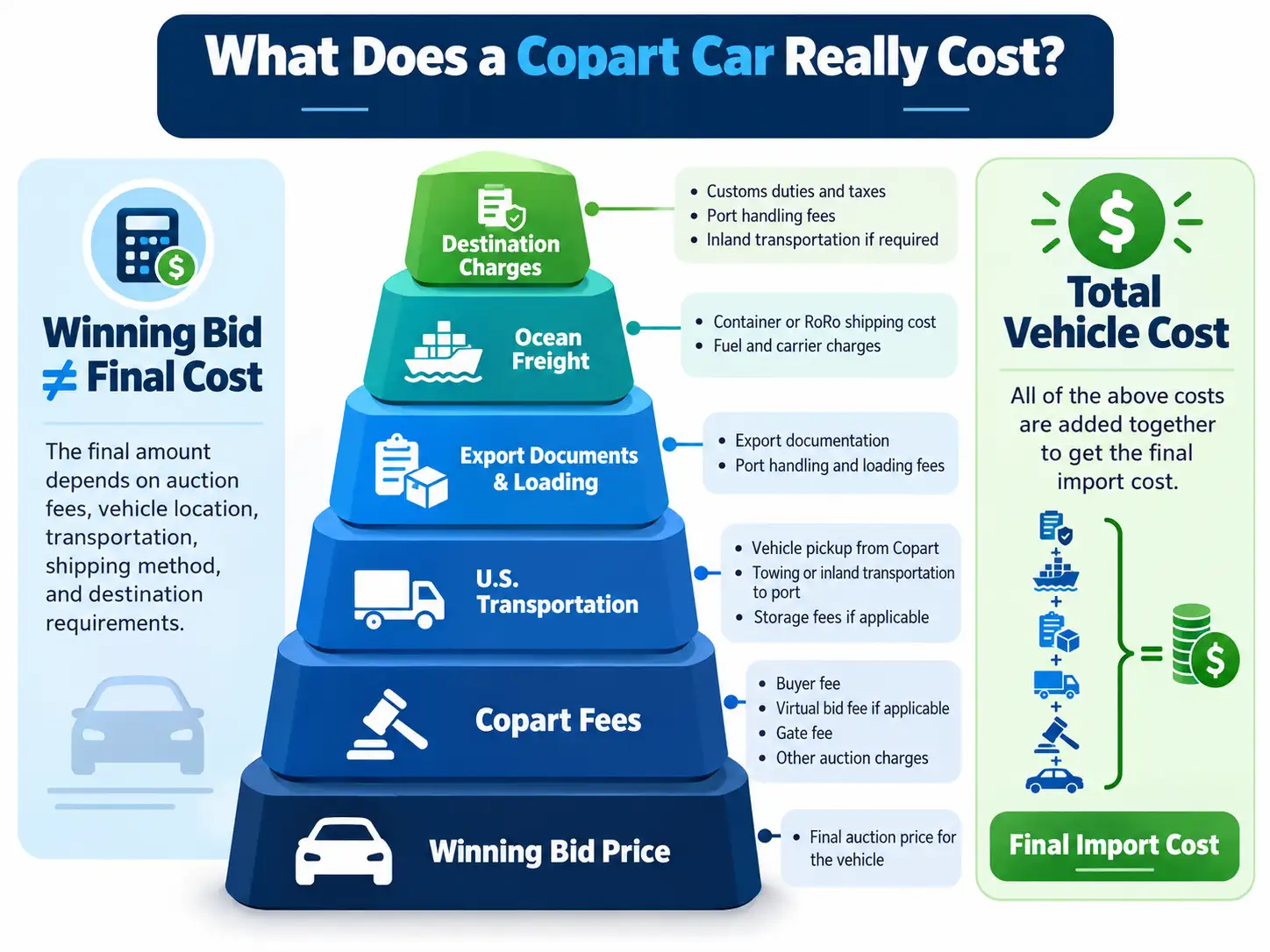
Every one of these varies. Auction fees change with the sale price tier, title group, payment method, purchasing history and other account factors. Towing cost depends on distance from the Copart yard to the loading facility. Storage cost depends entirely on how quickly you or your logistics provider act after winning. Ocean freight and destination charges depend on the shipping lane, the vessel schedule, and the destination country's own port and customs fee structure. Duties and import taxes depend on the destination country's current tariff schedule and any exemptions or vehicle age rules that apply there. There is no single number that represents "the" cost of buying from Copart, and any article, including this one, that quotes one flat figure as universal should be treated with caution.
California and Colorado are two locations where direct buyers should pay close attention to sales tax. When a qualifying purchase is made through PGL's broker account, the transaction can be handled under PGL's applicable business and tax setup, so the sales tax that may apply to a direct buyer is not charged on qualifying broker purchases. Other Copart fees still apply.
What the domestic auction fees actually look like
Copart does not use one flat buyer fee. Fees change with the final bid price, title group, payment method, bidding method, and the account's pricing status.
A new account does not automatically receive Copart's lower Preferred Pricing. Once an account has purchased at least 25 vehicles and reached at least $75,000 in annual vehicle purchases, it qualifies for Copart's Preferred Pricing. Meeting only one requirement is not enough. For example, buying 30 vehicles will not qualify the account if the $75,000 purchase threshold has not been reached. Accounts that qualify for Preferred Pricing benefit from lower buyer fees than newer or lower volume accounts.
This matters because Preferred Pricing carries lower buyer fees. Accounts that have not met both thresholds remain on the more expensive Standard Pricing schedule.
Clean title and non-clean title fees
Title group also changes the fee. Under Copart's Licensed Preferred Pricing, clean title and non-clean title vehicles follow different fee tables. Non-clean title vehicles generally carry higher buyer fees, gate fees, and virtual bid fees at comparable bid levels.
| Fee example | Clean title - Preferred Pricing | Non-clean title - Preferred Pricing |
| Gate fee | $79 | $95 |
| Pre bid fee at $8,000+ | $129 | $140 |
| Live bid fee at $8,000+ | $149 | $160 |
| Secured buyer fee at $9,000-$9,999.99 | $715 | $820 |
Payment method matters too. Secured payment methods carry lower buyer fees than unsecured methods. Before setting a maximum bid, check the vehicle's title group, your account pricing status, and how the payment will be made.
Real PGL auction example
A recent PGL Copart purchase shows the difference between the winning bid and the amount actually due. A 2025 Toyota Camry XSE Two Tone sold for $10,900, but the final Copart invoice was $12,040 before towing, loading, shipping, repairs, customs, or destination charges.
| Charge | Amount |
| Sale price | $10,900 |
| Buyer fee | $850 |
| Virtual bid fee | $160 |
| Gate fee | $95 |
| Environmental fee | $15 |
| Title pickup fee | $20 |
| Net due | $12,040 |
That is $1,140 in Copart charges, about 10.5% above the winning bid. This transaction used the non-clean title Preferred Pricing schedule. The $20 title pickup fee applied because the title was collected in person. The example shows why the winning bid should never be treated as the final purchase cost.
The full international landed cost
Domestic auction fees are only the first layer. The complete international total looks like this:
Winning bid + domestic auction fees + broker fee, if applicable + U.S. towing to a loading facility + storage, if pickup is delayed + title and export document handling + warehouse and loading charges + international ocean freight + destination port and customs handling + import duties or taxes, where applicable + final inland delivery
For lower value vehicles, shipping is where the math changes the most. Ocean freight and destination charges are largely tied to the space a vehicle occupies, not its purchase price, so a $2,000 car can face close to the same freight bill as a $10,000 one on the same route. That makes freight a proportionally enormous cost on a cheap vehicle and a comparatively small one on an expensive vehicle, which is exactly why some low value, heavily damaged cars that look like bargains at auction are not actually worth exporting once shipping is added in.
Getting an actual freight quote for your specific destination before bidding, rather than assuming shipping is a minor add on, is one of the more valuable five minute checks an international buyer can do. PGL can help estimate that logistics portion, towing, loading, and international freight, before you set your maximum bid, which is the point at which the estimate is actually useful rather than a number you look up after you have already won.
You can use PGL’s shipping cost calculator for an initial estimate, then confirm the route-specific charges before setting your maximum bid.
What Happens After You Win a Copart Vehicle?
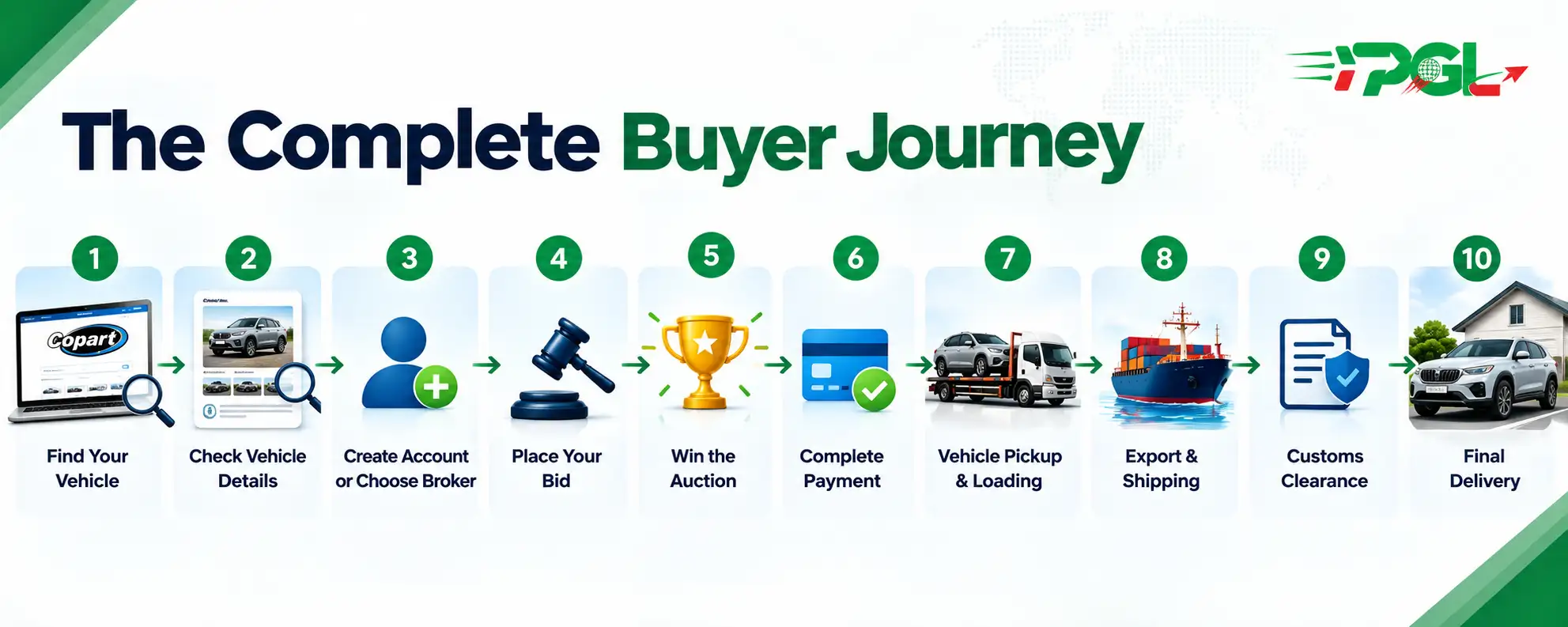
Winning the auction is roughly the midpoint of an international buyer's journey, not the end of it. The full path looks like this:
Research the vehicle → Understand the listing and title → Estimate total landed cost → Choose direct buying or a broker → Set a maximum bid → Bid → Win → Pay within the deadline → Arrange pickup quickly → Tow the vehicle from the auction yard → Receive it at a loading facility → Inspect and document its condition → Handle title and export paperwork → Load it into a container → Ship internationally → Track the shipment → Clear destination customs where applicable → Receive the vehicle at home
A basic auction registration guide generally stops at "pay and pick up." For an international buyer, everything from pickup onward is where the real coordination happens, and where delays or mistakes get expensive fastest.
Immediately after paying, the priority is arranging pickup before the complimentary storage period at the Copart yard expires. From there, the vehicle needs to reach a facility equipped to receive, inspect, document, and load it for international shipment, since a Copart auction yard is not itself set up to prepare a vehicle for containerized export. This is the handoff point where many independent international buyers lose time and money, coordinating a domestic tow truck, then a separate warehouse or consolidator, then a freight forwarder, often across time zones and without a single point of contact who has seen the vehicle in person. A broker with its own U.S. receiving facility, such as PGL's location in Savannah, Georgia, collapses that into one coordinated handoff instead of several separate vendor relationships.
How Do International Buyers Get the Vehicle Title?
Winning and paying for the vehicle does not automatically put the physical title in your hands. International buyers usually need the title released to a U.S. address, transporter, or shipping provider, and a Limited Power of Attorney may be required depending on how it is collected or mailed.
Most title delivery methods require a valid Limited Power of Attorney on file. Copart currently charges $20 per title for in person pickup. Up to 10 titles from a single location can be mailed for $15 by USPS or $20 by FedEx. Copart does not currently mail vehicle titles directly to international addresses, so international buyers normally use a U.S. address, transporter, shipping provider, or broker. If the vehicle was purchased through a broker, the title is generally obtained through that broker.
This is another reason to decide who will handle the vehicle and its documents before bidding. A delayed or incorrectly routed title can hold up the export process even when the car itself is already sitting at the loading facility.
How Do You Ship a Copart Car Internationally?
Once a purchased vehicle is towed off the Copart yard, it needs to reach a facility set up to receive it, document it, and prepare it for international transport. The core steps are consistent regardless of who handles them:
Receiving and inspection. On arrival at the loading facility, the vehicle is checked in, photographed, and inspected against the condition described at auction, which is the point where any transport damage or discrepancies from the listing should be documented while there is still time to address them.
Title and export documentation. The vehicle's title or ownership document is processed for export. Under U.S. export rules (19 CFR 192.2), the vehicle and its ownership documents must be presented to U.S. Customs and Border Protection (CBP) at least 72 hours before it leaves by ship. The export must also be filed electronically through the Automated Export System (AES), which gives the shipment an Internal Transaction Number (ITN). Different procedures can apply to junk, scrap and other nonstandard ownership documents.
Container loading. PGL ships purchased vehicles by container rather than by roll on/roll off transport. Its container loading services secure each vehicle inside a shipping container for the ocean voyage.
Ocean transportation and tracking. Once loaded, the container moves by vessel to the destination port. Buyers working with PGL can follow their shipment's progress through the PGLSystem, PGL's tracking platform, rather than relying on periodic emails or phone updates.
Destination customs and delivery. On arrival, the vehicle goes through the destination country's own customs clearance process, which varies by country in its documentation requirements, applicable duties or taxes, and any vehicle age or emissions restrictions, before final inland delivery to the buyer. Whether you are shipping to Ukraine, Poland, the UAE, Oman, Iraq's Kurdistan region, Turkmenistan, or a market elsewhere in Africa, Europe, Middle East, these destination side rules are set independently by each country and are worth confirming for your specific vehicle before you bid, not after it has already left the port.
For an overview of the process and its benefits, see PGL’s guide to container shipping for cars and vehicles.
Buying Directly vs Using a Copart Broker
Neither route is automatically better. The right one depends on what the buyer already has in place and how much they want to manage personally.
Buying directly from Copart tends to make sense for a buyer who:
- Already has the eligibility required for their target vehicles
- Understands Copart's bidding, payment, and pickup procedures well enough to move quickly
- Can arrange U.S. payment and meet short deadlines without added coordination delay
- Has researched the title type and export implications of their specific vehicle
- Has their own plan, or an existing relationship with a carrier, for domestic towing and international shipping
Using a broker tends to make sense for a buyer who:
- Wants to bid on inventory they cannot access directly
- Is new to Copart and wants experienced bidding support rather than learning the platform under pressure
- Lives outside the United States and would rather not coordinate towing, a receiving facility, export documentation, and ocean freight as separate vendor relationships
- Prefers one point of contact and one accountable party across the purchase and the shipment, rather than several
PGL operates as an Official Copart Broker, with its own U.S. pickup and international shipping operation. This allows PGL to support the vehicle from bidding and purchasing through towing, receiving, title and export handling, container loading, and international shipment.
For international buyers, this is the main advantage of working with PGL: instead of arranging several separate companies after winning the vehicle, the purchase and shipping process can be managed through one connected logistics partner.
Common Mistakes International Buyers Should Avoid Before Bidding on Copart
A few patterns show up repeatedly among buyers who end up disappointed with a Copart purchase, and nearly all of them can be avoided with a little planning before the auction.
- Bidding on the current bid shown, not a calculated maximum. The number on screen is what other people have offered so far, not a ceiling you set for yourself.
- Ignoring auction fees when setting a bid. Buyer's fees, internet fees, and gate fees add up quickly and change what a "good deal" actually costs.
- Not accounting for towing distance. A vehicle at a yard several states away from your loading facility can cost meaningfully more to move than one nearby, and that cost is easy to forget while focused on the bid itself.
- Treating "Run and Drive" as a mechanical guarantee. It describes a moment at intake, not a promise about how the car will behave at pickup or after shipping.
- Assuming photos show everything. Undercarriage damage, interior condition, and hidden mechanical issues are frequently underrepresented in listing photos.
- Bidding before checking title or document type and its export implications. By the time this is discovered after winning, options are limited and costly.
- Overlooking the destination country's own import rules. A vehicle that is easy to export from the U.S. can still be difficult to register at home, depending on its age, emissions profile, and title status.
- Entering live bidding without a firm total budget in mind. Auction adrenaline is real, and a maximum set in advance is easy to abandon in the moment without one written down beforehand.
- Arranging transportation only after winning. Storage fees start accumulating on a clock that does not pause for logistics planning.
- Not planning payment timing. International wire transfers take longer to clear than domestic ones, and the payment deadline does not move to accommodate that.
None of these mean buying from Copart is unusually risky. They mean it rewards preparation, and punishes buyers who treat the bid as the whole transaction instead of the first step in one.
Is Buying From Copart Worth It for International Buyers?
For the right vehicle, and the right buyer, yes, it regularly is. Copart gives international buyers access to a volume and variety of U.S. vehicle inventory that is difficult to match through any other single channel, and plenty of exporters, rebuilders, and dismantlers build entire businesses around it.
It is worth it specifically for buyers who go in with a realistic total cost in mind, who check title type and export and import implications before bidding, and who have a plan for pickup and shipping ready before the auction closes rather than scrambling once they have won. It is a poor fit for a buyer expecting every listing to be an easy bargain, treating condition terminology as a guarantee, or assuming the winning bid is close to the final cost.
Want PGL to handle the process? Buyers who would rather not manage auction bidding, pickup, title work, and international shipping as separate tasks can work with PGL from the initial purchase through delivery at the destination, as a single coordinated service rather than several disconnected ones. Contact PGL to discuss your purchase and shipping requirements.
Frequently Asked Questions
1. Can I inspect a Copart vehicle before bidding if I live outside the United States?
Any registered member can preview eligible vehicles in person at a Copart yard during regular business hours, but that is rarely practical for a buyer based overseas. Most international buyers rely on the listing photos, the VIN, third party history reports, and, where available, a broker's or agent's evaluation, rather than an in person visit.
2. What happens if I win a vehicle but cannot arrange pickup in time?
The vehicle can still be picked up after the complimentary storage period, but storage charges begin and increase the longer it remains at the yard. Current schedules start at $5 and rise on later days. If the vehicle is also unpaid for 8 calendar days, it can be relisted and the applicable relist fee will be charged. This is why transport and payment should be planned before bidding, not after winning.
3. Do I need any special license to export a vehicle I bought from Copart?
Buying the vehicle and exporting it are governed by different rules. Purchasing eligibility depends on the vehicle, account and applicable state requirements. Exporting is a separate federal process centered on the vehicle's ownership documentation, VIN, export filing and timing requirements.
4. Can a salvage titled vehicle still be shipped internationally?
Generally, yes. A salvage title is not automatically an export prohibition. The exact ownership documentation still has to satisfy U.S. export requirements, and whether the vehicle can later be registered for road use depends on the destination country's own rules.
5. Is there an age limit on vehicles I can buy and ship?
Not from the U.S. export side as a general rule. Many destination countries do restrict the age of vehicles that can be imported and registered, and these limits vary widely and change periodically, so they need to be checked against the specific destination country's current rules rather than assumed.
6. How do international buyers receive their Copart title?
Most international buyers have the title released to a U.S. address, transporter, shipping provider, or broker. A Limited Power of Attorney may be required, and Copart does not currently mail titles directly to international addresses.
7. Do I have to buy through Copart's website, or does PGL bid on my behalf?
As an Official Copart Broker, PGL can bid and purchase through its Copart account on a client's behalf; the client works with PGL under PGL's own terms rather than registering and transacting directly for that purchase.
Conclusion
Buying a car from Copart as an international buyer is entirely doable, and buyers around the world do it successfully every day. The difference between a purchase that goes smoothly and one that turns into an expensive lesson usually comes down to a handful of decisions made before the bid, not after it: understanding whether a vehicle requires eligibility you do not have, reading condition and title terminology for what it actually confirms rather than what it implies, calculating a real landed cost instead of bidding on the auction price alone, and having pickup and shipping arranged before you win rather than scrambling once you have.
Whether you handle each of those steps yourself or work with a broker to combine them into one process, the underlying homework does not change. Getting it right the first time is a great deal cheaper than fixing it after the vehicle has already landed.